Leonardo Da Vinci Art History Raphael Stanza Della Segnatura
The Story Behind Raphael'southward Masterpiece 'The School of Athens'
This post may incorporate affiliate links. If you make a purchase, My Modern Met may earn an affiliate commission. Please read our disclosure for more info.
Long before Rafael the hotheaded, blood-red-heart mask-wearing Teenage Mutant Ninja Turtle entertained children onscreen, there was Rafael the esteemed painter who'd won over a cultured crowd of art connoisseurs. Past his mid-20s, Raphael Sanzio was already a star. At the top of his game, this master of the Italian Renaissance had been invited by the pope to live in Rome, where he would spend the residuum of his days. Starting in 1509 he began decorating the first of four rooms in the Papal Palace. Collectively, these Raphael Rooms, along with Michelangelo'southward Sistine Chapel exemplify the High Renaissance fresco technique.
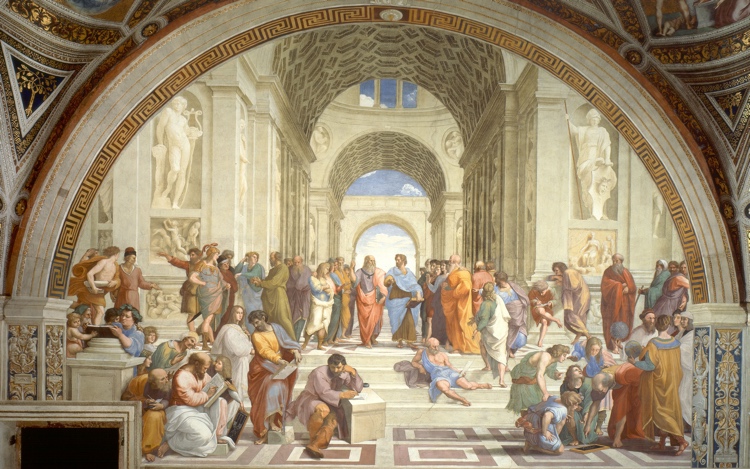
In particular, Raphael's fresco The Schoolhouse of Athens has come up to symbolize the wedlock of art, philosophy, and science that was a hallmark of the Italian Renaissance. Painted between 1509 and 1511, it is located in the start of the four rooms designed by Raphael, the Stanza della Segnatura.
Merely just what does this famous painting hateful? Let's look at what the iconic The School of Athens meant for Raphael as an artist and how it'south get such a symbol of the Renaissance. At the time, a commission by the pope was the noon of any artist's career. For Raphael, it was validation of an already burgeoning career.
"The Schoolhouse of Athens" preparatory cartoon
Raphael was in Florence when he received word that Pope Julius 2, the same man who asked Michelangelo to paint the Sistine Ceiling, asked him to decorate apartments on the 2d floor of the Vatican Palace. He was hoping to outshine the Early on Renaissance paintings his predecessor, Pope Alexander 6, had washed in the Borgia Apartments, which sat directly below. It could be seen as a bold selection, as a young Raphael had never executed fresco works equally circuitous equally the commission would require. At that betoken, he'd mainly been known for his small portraits and religious paintings on wood, in improver to a few altarpieces. Some believe that his friend Bramante, who was the builder of St. Peter's, recommended him for the chore. They'd both grown upward in Urbino and knew each other well.
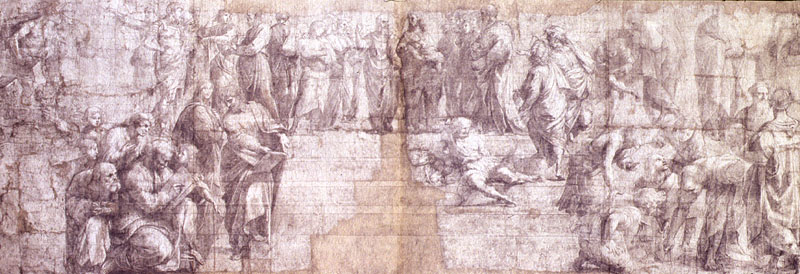
Raphael rose to the claiming, creating an extensive catalog of preparatory sketches for all his frescoes. These would later exist blown upward in full-calibration cartoons to aid transfer the design to the wet plaster. Working at the aforementioned time as Michelangelo, it's thought that this helped push and inspire Raphael by stimulating his competitive nature.
Stanza della Segnatura and the Iv Branches of Knoweldge
The School of Athens is one of 4 wall frescoes in the Stanza della Segnatura. Each wall represents one of the four branches of knowledge during the Renaissance—theology, literature, justice, and philosophy. The room was set to exist Julius' library, and therefore Raphael'southward overall concept balances the contents of what would have been in the pope's study.
In the 15th century, a tradition of decorating private libraries with portraits of corking thinkers was mutual. Raphael took the idea to a whole new level with massive compositions that reflected the iv branches. Read as a whole, they immediately transmitted the intellect of the pope and would have sparked discussion between cultured minds that were lucky enough to enter into this private infinite.
The School of Athens was the third painting Raphael completed afterDisputa (representing theology) and Parnassus (representing literature). Information technology's positioned facingDisputa and symbolizes philosophy, setting upward a contrast between religious and lay beliefs.
Have a virtual tour of the Stanza della Segnatura via the Vatican Museums website.
The School of Athens
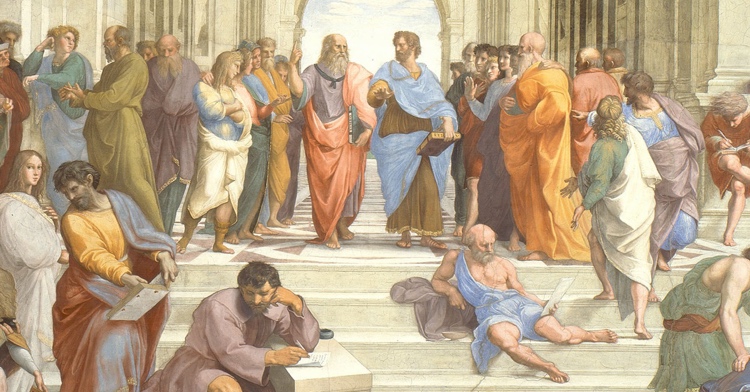
Set in an immense architectural illusion painted by Raphael, The Schoolhouse of Athens is a masterpiece that visually represents an intellectual concept. In ane painting, Raphael used groupings of figures to lay out a circuitous lesson on the history of philosophy and the unlike beliefs that were adult past the great Greek philosophers.
Raphael certainly would accept been privy to private showings of the Sistine Chapel in progress that were arranged by Bramante. Though Raphael's work, in many ways, could exist seen as more circuitous due to the number of figures placed in one scene, he certainly was influenced by the great creative person's work. This is specially evident by the long figure thinking in the foreground, as we'll before long see.
In fact, modern influence seeps in more than frequently than one would retrieve, particularly when it comes to the faces used for certain figures in The School of Athens. Allow'southward take a await, group by group, to pick apart the concept and see who appears in the famous fresco.
Who are the figures inThe School of Athens?
Plato and Aristotle
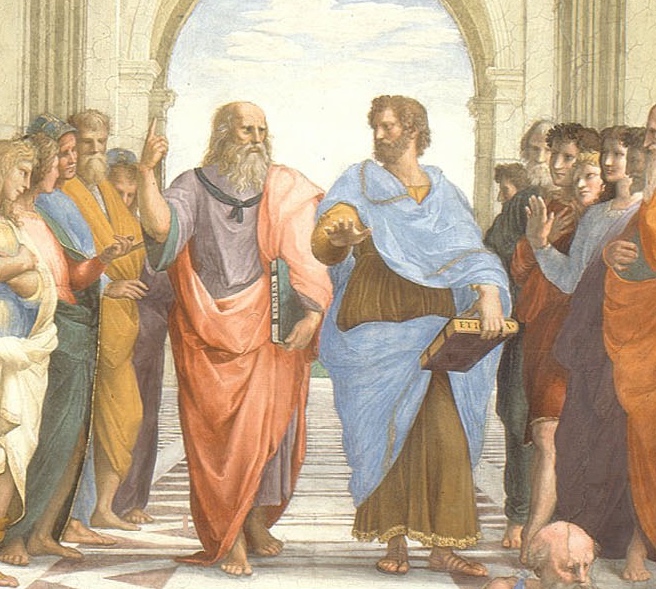
The two chief figures in the work are placed direct under the entrance and in the fresco's vanishing point, a compositional trick to depict the viewer's center to the most important part of the painting. Hither, nosotros see 2 men who finer correspond the dissimilar schools of philosophy—Plato and Aristotle.
An elderly Plato stands at the left, pointing his finger to the heaven. Beside him is his educatee Aristotle. In a brandish of superb foreshortening, Aristotle reaches his right arm directly out toward the viewer. Each human holds a copy of their books in their left hand—Timaeus for Plato and Nicomachean Ideals for Aristotle.
Plato's gesture toward the heaven is thought to indicate his Theory of Forms. This philosophy argues that the "real" world is not the physical one, but instead a spiritual realm of ideas filled with abstract concepts and ideas. The concrete realm, for Plato, is but the material, imperfect things we run into and interact with on a daily ground. Interestingly, some people believe that Raphael used Leonardo da Vinci's face for Plato, based on similarities from his cocky-portrait.
Conversely, Aristotle's hand is a visual representation of his belief that knowledge comes from experience. Empiricism, equally it is known, theorizes that humans must accept concrete prove to support their ideas and is very much grounded in the physical world.
Scholars debate that this split up in philosophies, placed at the center of The School of Athens, is the core theme of the painting.
And then who is everyone else? It's not always crystal articulate, as Raphael doesn't arm all his characters with attributes that give away their identity. Fortunately, there are quite a few that scholars tin agree on.
Socrates
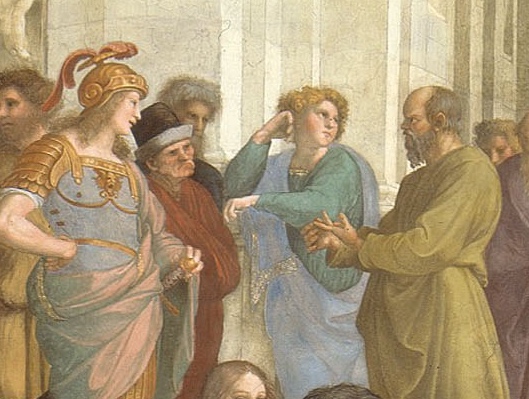
To the left of Plato, Socrates is recognizable thanks to his distinct features. Information technology's said that Raphael was able to use an aboriginal portrait bust of the philosopher as his guide. He's also identified by his mitt gesture, every bit pointed out by Giorgio Vasari inLives of the Artists. "Even the Manner of Reasoning of Socrates is Express'd: he holds the Fore-finger of his left mitt between that, and the Thumb of his Correct, and seems as if he was proverb You grant me This and This."
Among the crowd surrounding Socrates are his students, including the full general Alcibiades and Aeschines of Sphettus.
Pythagoras
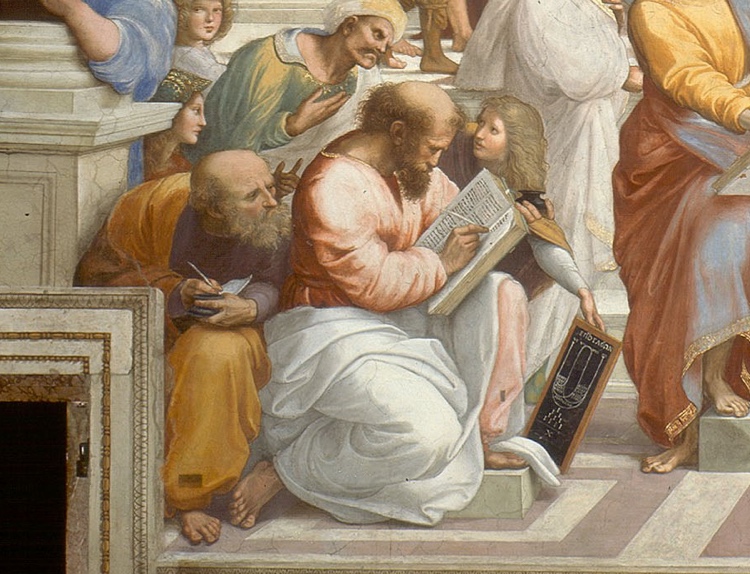
In the foreground, Pythagoras sits with a book and an inkwell, as well surrounded by students. Though Pythagoras is well known for his mathematical and scientific discoveries, he also firmly believed in metempsychosis. This philosophy states that every soul is immortal, and upon death, moves to a new physical body. In this light, it makes sense that he would be placed on Plato's side of the fresco.
Euclid
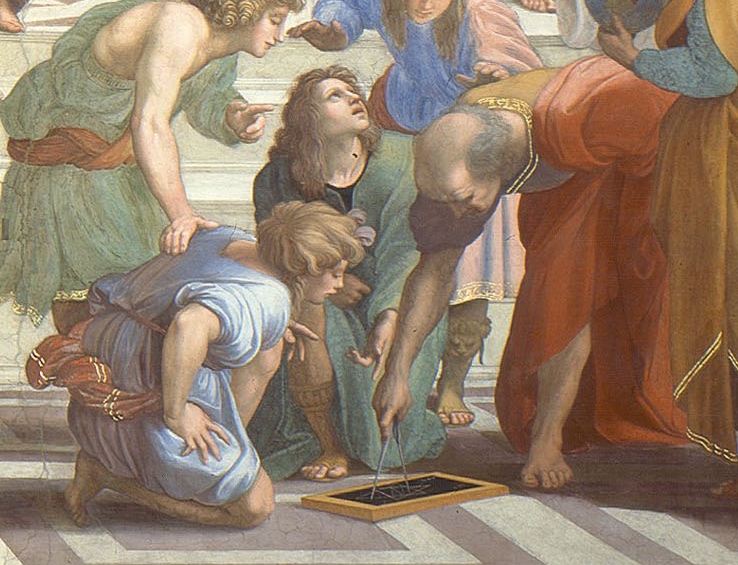
Mirroring Pythagoras' position on the other side, Euclid is bent over demonstrating something with a compass. His young students eagerly endeavour to grasp the lessons he'due south educational activity them. The Greek mathematician is known as the father of geometry, and his love of concrete theorems with verbal answers demonstrates why he represents Aristotle's side of The School of Athens. Experts believe that Euclid is a portrait of Raphael'due south friend Bramante.
Ptolemy
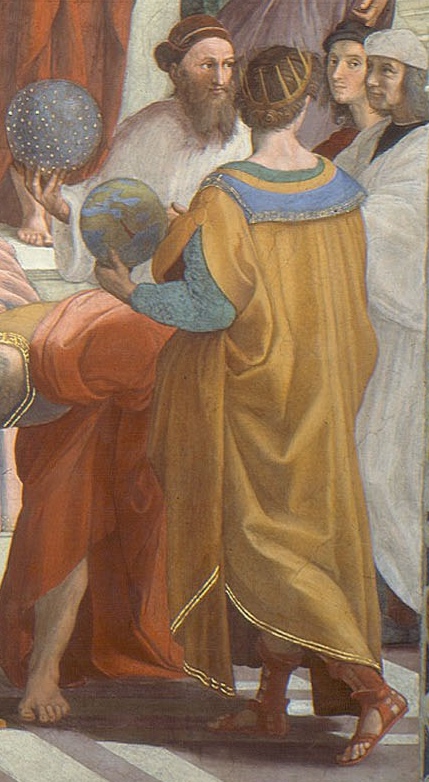
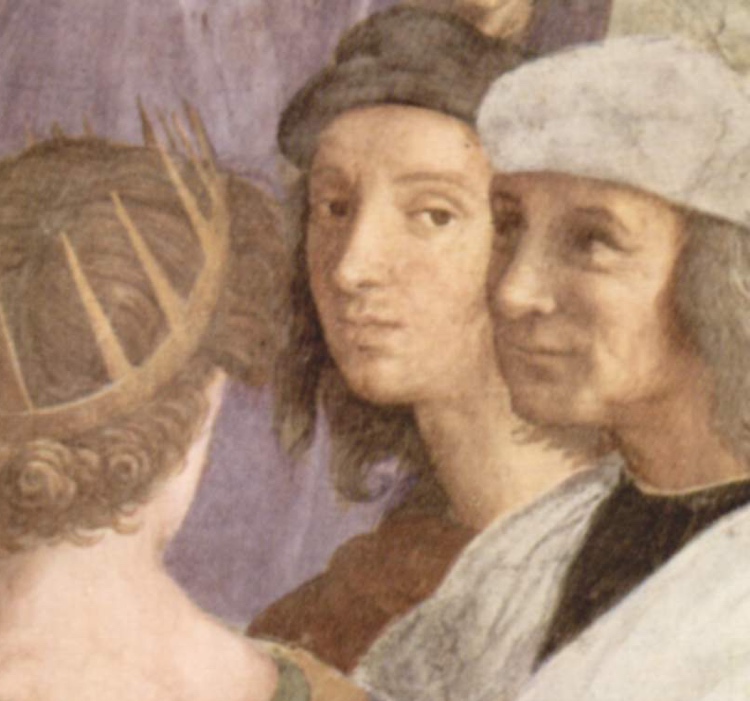
The great mathematician and astronomer Ptolemy is right next to Euclid, with his back to the viewer. Wearing a yellow robe, he holds a terrestrial globe in his hand. Information technology's thought that the bearded man standing in front of him holding a angelic globe is the astronomer Zoroaster. Interestingly, the fellow standing next to Zoroaster, peaking out at the viewer, is none other than Raphael himself. Incorporating this type of self-portrait is non unheard of at the time, though it was a bold move for the artist to contain his likeness into a work of such intellectual complication.
Diogenes
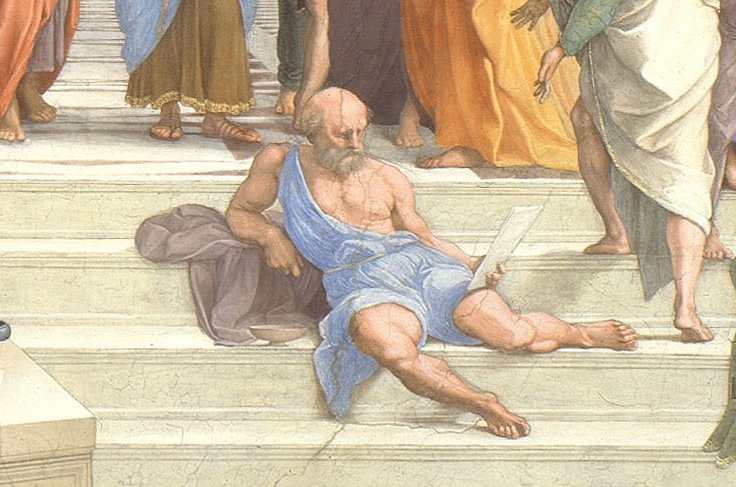
It's universally agreed that the older gentleman sprawled on the steps is Diogenes. Founder of the Cynic philosophy, he was a controversial effigy in his day, living a simple life and criticizing cultural conventions.
Heraclitus
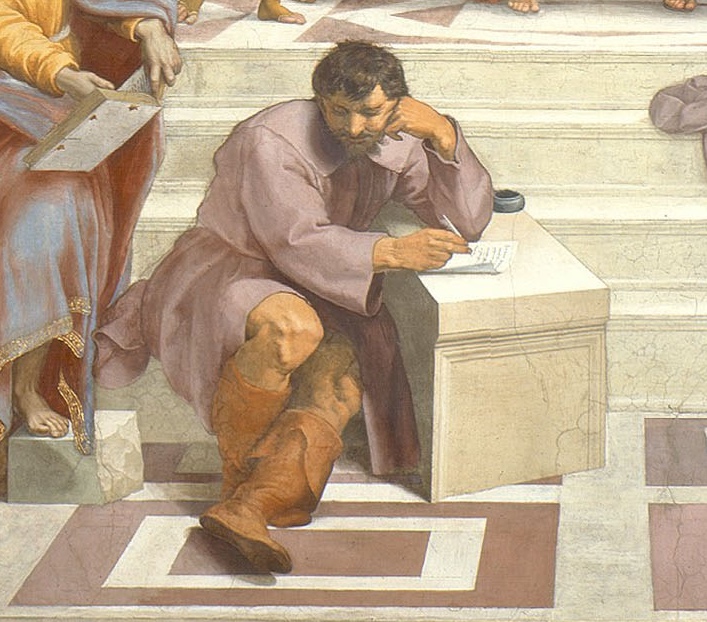
One of the most hitting figures in the limerick is a brooding man seated in the foreground, hand on his caput in a classic "thinker" position. This figure doesn't bear witness up in Raphael's preliminary drawings and plaster analysis shows that it was added later. Fine art historians Roger Jones and Nicholas Penny write in their book Raphael that it "is probably Raphael'due south first attempt to appropriate some of the heavyweight ability of Michelangelo's Sistine Prophets and sibyls."
Long idea to be a portrait of Michelangelo himself, the heart-searching nature would take matched the artist's grapheme. In the realm of philosophers, he is Heraclitus, a cocky-taught pioneer of wisdom. He was a melancholy character and did not savour the company of others, making him one of the few isolated characters in the fresco.
Statues
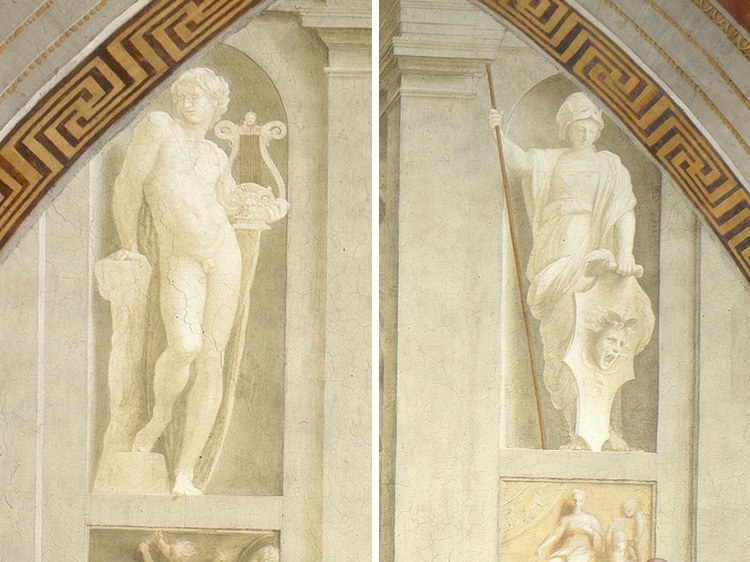
Rounding out Raphael'southward program, two large statues sit in niches at the back of the school. On Plato's correct, we see Apollo, while on Aristotle's left is Minerva. Minerva, the goddess of wisdom and justice, is an apt representative of the moral philosophy side of the fresco. Interestingly, her positioning besides places her shut to Raphael'due south fresco almost jurisprudence, which unfolds direct to her left.
Apollo, recognizable by his lyre, represents the natural philosophy side. Every bit the god of lite, music, truth, and healing, his position puts him adjacent to Raphael's Parnassus fresco representing literature and poetry.
Since its cosmos, The School of Athens was a success, bringing Raphael subsequent commissions by the pope and making him one of the most sought-after artists in Rome. Though Raphael's life was short—he died in 1520 at age 37—his impact has endured over the centuries. He'south still considered one of the bang-up masters of the Italian Renaissance, with his piece of work influencing artists even today.
All images via Raphael [Public domain], via Wikimedia Eatables except where noted.
This article has been edited and updated.
Related Articles:
The History and Legacy of Leonardo da Vinci's Mysterious "Mona Lisa"
8 Renaissance Artists Whose Work Transformed the Art World
The Significance of Botticelli's Renaissance Masterpiece 'The Birth of Venus'
The Significance of Leonardo da Vinci's Famous "Vitruvian Man" Drawing
Art History: The Meaning Behind Michelangelo's Iconic 'David' Statue
0 Response to "Leonardo Da Vinci Art History Raphael Stanza Della Segnatura"
Postar um comentário